
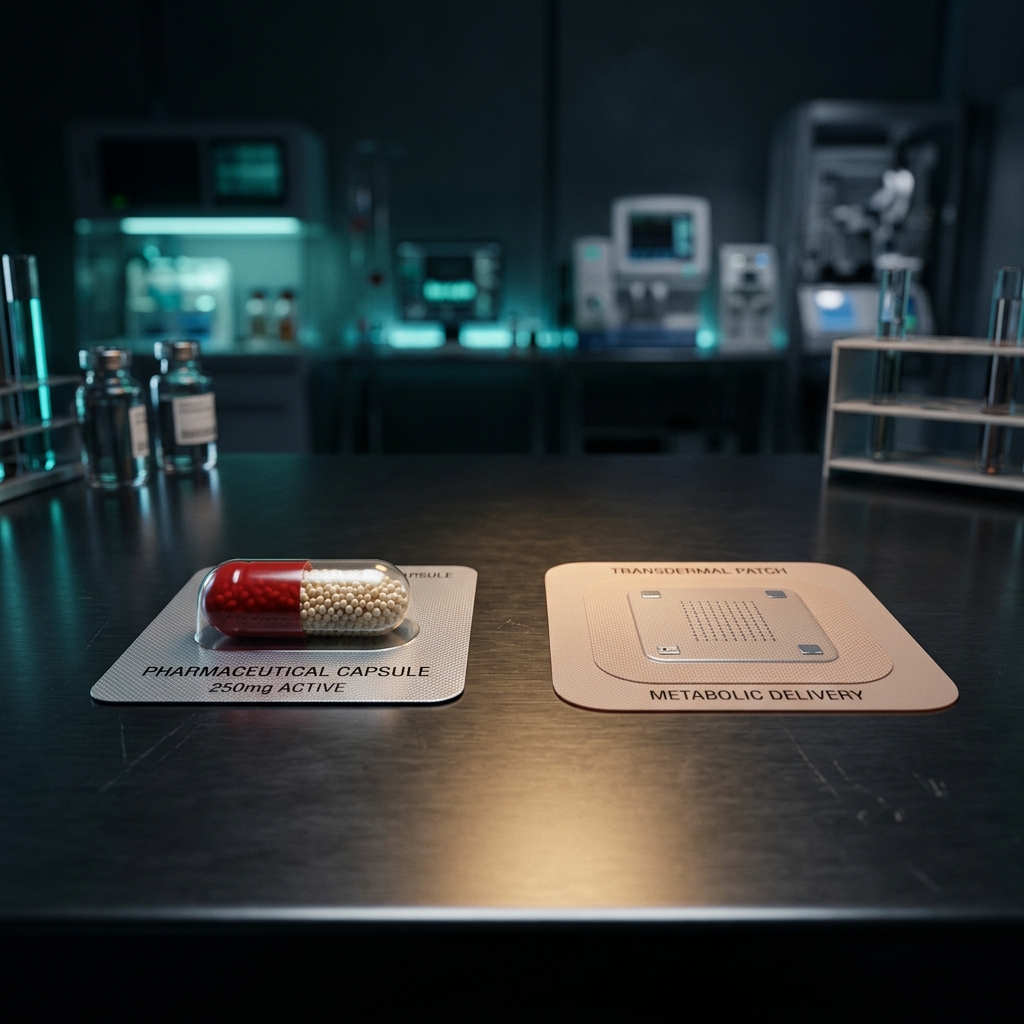
In the pursuit of metabolic optimization, the active ingredient is only half the battle. Whether you are attempting to lower HbA1c with berberine, replace declining NAD+ levels, or utilize GLP-1 agonists for weight loss, the most profound biological bottleneck is delivery. A 1,000mg capsule of a miracle compound is utterly useless if it never enters your bloodstream.
The debate of transdermal vs oral bioavailability is the most critical conversation in modern pharmacology. For decades, patients have accepted debilitating gastrointestinal side effects and massive dose degradation as the "cost of doing business" with oral supplements. Today, that is no longer acceptable.
In this 5,000+ word definitive guide, we will analyze the pharmacokinetic profiles of the three primary drug delivery mechanisms: Oral, Transdermal, and Subcutaneous Injections. We will break down exactly why the liver destroys oral compounds, how transdermal patches provide steady-state absorption, and why certain massive molecules (like Semaglutide) must be injected.
Stop Wasting Your Supplements
Oral berberine has less than 1% bioavailability. Upgrade to transdermal delivery for maximum metabolic impact.
Shop Transdermal BerberineUnderstanding Bioavailability
Bioavailability is the fundamental metric of drug delivery. It represents the percentage of an administered dose of unchanged drug that successfully reaches the systemic circulation (the bloodstream). If a delivery method has 100% bioavailability, every milligram you take makes it to your cells. If it has 1% bioavailability, 99% of the dose is destroyed or excreted.
1. Oral Delivery: The First-Pass Trap
Oral delivery is the most common, cheapest, and easiest method of administration. It is also, biologically, the most hostile and inefficient path a molecule can take.
The Gauntlet
When you swallow a capsule, the compound must first survive the extreme acidity of the stomach. If it survives, it enters the small intestine, where it must dissolve in intestinal fluids and cross the epithelial lining. As we detailed in our breakdown of berberine oral bioavailability, this is where P-glycoprotein efflux pumps actively push the molecule back into the gut.
If the molecule manages to cross the intestinal wall, it enters the portal vein, which routes it directly to the liver. This is the ultimate trap: Hepatic First-Pass Metabolism. The liver acts as the body's primary filter, utilizing CYP450 enzymes to metabolize and destroy foreign compounds before they can reach the heart and systemic circulation. For compounds like berberine or NAD+, the liver destroys roughly 95-99% of the active ingredient.
The Toxicity Spike
Because oral delivery is so inefficient, manufacturers must cram massive, 1,000mg to 2,000mg doses into capsules to force a few milligrams through the liver. This causes a massive spike in plasma concentration, followed by a rapid crash. That initial spike is what triggers severe side effects, such as the infamous "Berberine Belly" (severe cramping and diarrhea).
2. Transdermal Delivery: Steady-State Precision
Transdermal delivery involves applying a medical-grade matrix patch to the skin. The active compound diffuses through the stratum corneum and directly into the capillary beds within the dermis.
Bypassing the Liver
Because the capillaries in your skin route blood directly to the systemic circulation (bypassing the portal vein), transdermal delivery completely avoids hepatic first-pass metabolism. A 50mg transdermal dose of dihydroberberine can yield higher, more stable plasma levels than a 1,000mg oral capsule.
Zero-Order Kinetics
Unlike the violent spikes and crashes of oral pills, transdermal drug delivery systems provide "zero-order release kinetics." The patch acts as an IV drip on your skin, delivering the compound at a continuous, steady rate over 24 hours. You remain constantly in the optimal therapeutic window without experiencing toxic spikes or gastrointestinal distress.
| Delivery Metric | Oral Capsule | Transdermal Patch |
|---|---|---|
| Hepatic First-Pass | Yes (High Degradation) | Bypassed Completely |
| GI Side Effects | Severe (Nausea, Diarrhea) | None |
| Plasma Profile | Sharp spikes and rapid crashes | Steady-state over 24 hours |
| Molecule Size Limit | Can tolerate larger molecules (but poor absorption) | Strictly limited (< 500 Daltons) |
Content Gap: The Subcutaneous Injection Necessity
If transdermal patches are so superior to oral pills, why aren't GLP-1 medications like Ozempic, Wegovy, or Tirzepatide administered via a simple skin patch?
The answer lies in molecular biology. Transdermal patches rely on passive diffusion through the dense, lipid matrix of the skin. To squeeze through this microscopic barrier, a molecule must be incredibly small—typically under 500 Daltons in molecular weight. Berberine (336 Daltons) and Dihydroberberine (339 Daltons) fit perfectly.
Semaglutide, the active peptide in GLP-1 medications, is a massive macromolecule with a molecular weight of 4,113 Daltons. It is physically impossible for a molecule that large to passively diffuse through the stratum corneum. If you put Semaglutide in a transdermal patch, 0% of it would enter your bloodstream. It would simply sit on top of your skin.
The Subcutaneous Route
To deliver massive peptides like GLP-1s, Tirzepatide, or Sermorelin, we must mechanically bypass the skin barrier using a tiny needle. Subcutaneous injections deliver the peptide directly into the fatty tissue just beneath the skin. From there, it is rapidly absorbed into the capillaries. This provides 100% bioavailability, zero first-pass liver metabolism, and avoids the gastrointestinal tract entirely.
Access Clinical-Grade Injections
Need the power of GLP-1 peptides? See if you qualify for compounded semaglutide or Tirzepatide prescribed by board-certified physicians.
Check GLP-1 EligibilityFrequently Asked Questions (FAQ)
If oral delivery is so bad, why does oral Semaglutide (Rybelsus) exist?
Rybelsus is an engineering marvel, but it proves the point. To get the massive Semaglutide molecule through the stomach, they combined it with a chemical absorption enhancer (SNAC). Even with this enhancer, the oral bioavailability of Rybelsus is roughly 1%. Patients must take a massive 14mg pill daily just to get the equivalent effect of a tiny 0.5mg weekly injection.
Do transdermal patches last for 72 hours?
No. While marketers claim this, the Fick's Law of Diffusion dictates that once the concentration gradient drops, delivery stops. The active compound in a standard matrix patch is depleted in 18 to 24 hours. We covered this exhaustively in our 72-hour patch myth expose.
Is transdermal Berberine better than Ozempic?
They are two different tools for two different levels of metabolic dysfunction. Berberine (via AMPK activation) is phenomenal for early-stage insulin resistance, while Ozempic (via GLP-1) is a clinical powerhouse for severe obesity. We compare them directly in our Berberine vs Ozempic clinical guide.
Are transdermal patches safe?
Yes, they are exceptionally safe because they avoid gastrointestinal damage. The only common side effect is mild contact dermatitis (skin irritation) from the adhesive. This is easily mitigated by rotating the patch application site daily.
Upgrade Your Metabolic Protocol
Stop flushing your money down the digestive tract. Choose transdermal delivery for targeted optimization, or subcutaneous injections for profound weight loss.
Academic References & Clinical Citations
- Liu, C. S., Zheng, Y. R., Zhang, Y. F., & Long, X. Y. (2016). Research progress on berberine with a special focus on its oral bioavailability. Fitoterapia, 109, 274–282. https://pubmed.ncbi.nlm.nih.gov/26921132/
- Prausnitz, M. R., & Langer, R. (2008). Transdermal drug delivery. Nature Biotechnology, 26(11), 1261–1268. https://pubmed.ncbi.nlm.nih.gov/18997767/
- Buckley, S. T., Bækdal, T. A., Vegge, A., Maarbjerg, S. J., Pyke, C., Ahnfelt-Rønne, J., ... & Kjær, A. (2018). Transcellular stomach absorption of a derivatized glucagon-like peptide-1 receptor agonist. Science Translational Medicine, 10(467), eaar7047. https://pubmed.ncbi.nlm.nih.gov/30429357/